From Curiosity to Confidence: Anar Bayanmunkh ’28 Explores Bioinformatics in Mongolia

How do you know whether a career path is right for you? Sometimes, you have to try it out.
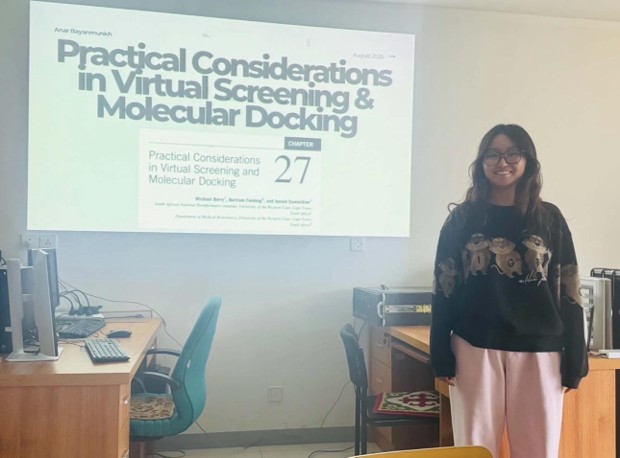
When Anar Bayanmunkh ’28 headed home to Mongolia this summer, she was excited to explore her growing interest in biology and neuroscience through a research internship at the National University of Mongolia. As the College shared before her departure, Anar hoped the experience would help her better understand the field and whether she wanted to pursue it further.

With support from a CCPD summer internship stipend, Anar spent the summer learning new research techniques, tackling unfamiliar scientific challenges, and discovering what she values in a future job. Along the way, she found new academic interests and gained a clearer sense of what she wants from her career.

Read Anar’s reflection on her summer experience below.

A day in my life this summer could mean sitting in a bioinformatics lab trying to understand a chemical bond I had never learned about, preparing a protein for molecular docking, or figuring out how something I had only seen in a research paper could actually apply to a real scientific problem. 

I spent my summer interning in a bioinformatics lab at the National University of Mongolia under Dr. Mijiddorj Batsaikhan. Throughout my internship, I read and presented research papers and learned molecular docking and virtual screening. I started by following tutorials to understand how the tools and different steps worked, then practiced preparing proteins and ligands and running docking experiments myself. As the summer continued, I gradually became more independent with the process. 

My favorite part came toward the end, when I worked through three different research scenarios, including a tuberculosis case study connected to my professor’s research. After spending weeks learning individual steps, I finally got to apply them to problems that felt real, which made the work much more exciting to me. 

The experience also taught me a lot about myself. I enjoy challenging scientific problems, especially when I can see their real-world purpose. At the same time, spending many quiet hours behind a computer made me realize how much I value interaction, collaboration, and community in a workplace. 

I was also pushed outside my academic background, especially with chemistry. Trying to understand molecular interactions without having taken college chemistry was challenging, but it made me curious enough to take chemistry this year and build on what I learned. 

I am especially grateful to Kalamazoo College’s CCPD for providing the stipend that made this experience possible. Without their support, I would not have imagined having an opportunity like this so early in college. – Anar Bayanmunkh ’28
What Research Taught Me That a Classroom Couldn’t

Son-Le-Dinh-Truong

How can the skills you’re developing at K help tackle a problem you’ve seen firsthand?

For Son Le ’28, a summer research internship at Kalamazoo College meant using computer vision and deep learning to address a real-world infrastructure challenge. Here’s Son on navigating the challenges of research, working across time zones, and discovering where he hopes to take this work next:

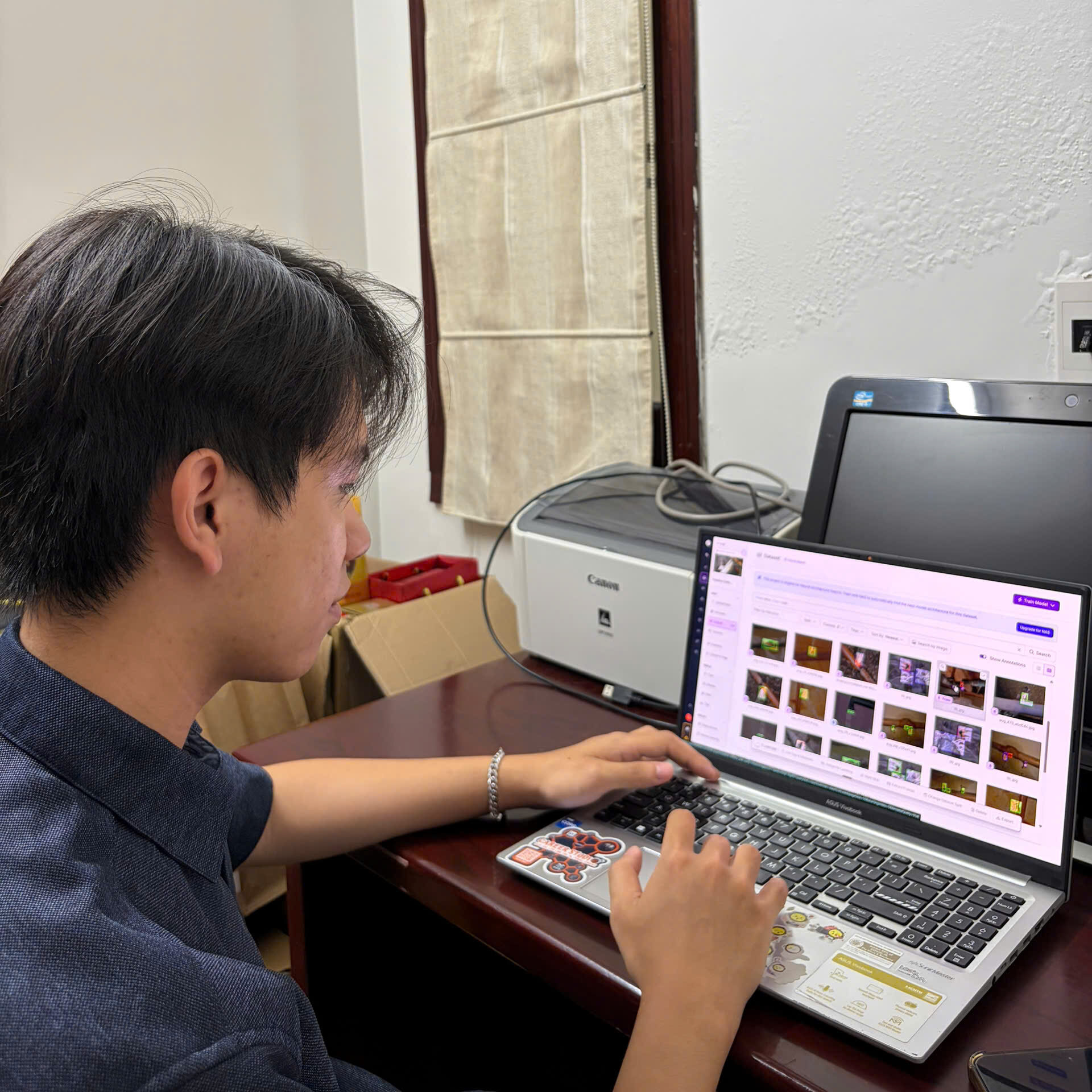
“This summer, I worked as a research intern at Kalamazoo College under Dr. Tasnim Gharaibeh, building a computer vision system that uses deep learning to detect defects in municipal water and sewer pipelines. The project is anchored in Vietnam’s aging tropical infrastructure, a context I know personally, having grown up in Ha Tinh. My work was funded through the CCPD’s Summer Internship Stipend, which made it possible for me to commit fully to research rather than choosing between this opportunity and a paying job. 

My work involved training YOLO-based object detection models to classify pipeline defects like holes, leaks, and rust from a dataset of over 2,000 annotated images. But one of the biggest challenges had nothing to do with the model itself. I was working with multiple datasets that labeled the same damage types differently, with no universal naming convention to unify them. Even Dr. Tasnim and I found no clear answer in the literature. That constraint led us to design a two-layer cascade architecture: a simple binary classifier first, then a multi-class model on top. The limitation shaped the solution. Research does not hand you a roadmap. You study the problem deeply, brainstorm every angle, and decide with limited resources. 

Working remotely across time zones added another layer. Dr. Tasnim was in her home country juggling several projects, so our communication windows were narrow. Finding a shared time slot meant rearranging my schedule, especially since I was also completing an industry internship and preparing for the next recruiting cycle. Balancing all three was mentally the hardest thing I have done. But Dr. Tasnim’s mentorship kept me grounded. She has a way of pulling your focus back when you start scattering, and I am deeply grateful for that. 

This experience confirmed that I want to pursue software engineering with a strong research foundation. Moving forward, I hope to build on this work by proposing it as my senior thesis at Kalamazoo College. Thank you to the CCPD for making this possible and to Dr. Tasnim for trusting me with work that genuinely matters.” – Son Le ’28

Lessons from a Startup Internship

 
What happens when an internship teaches you something you weren’t expecting to learn?

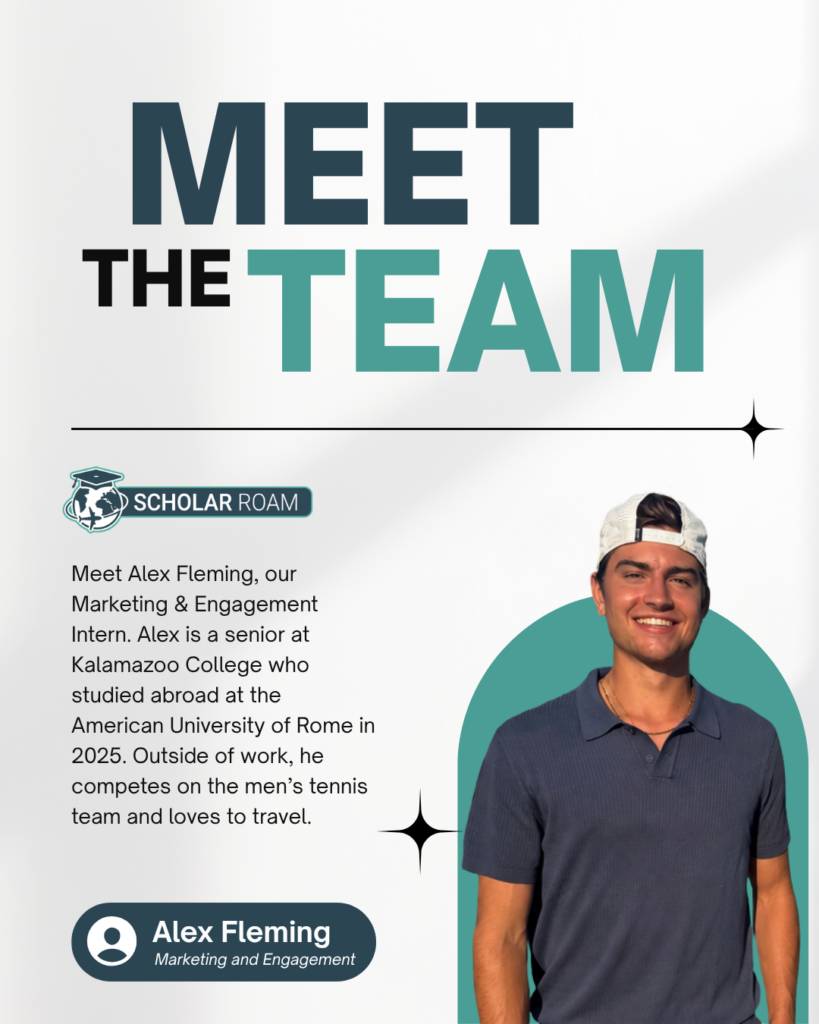
For Alex Fleming ’27, a summer internship with ScholarRoam offered hands-on experience in marketing, design, outreach, and the day-to-day work of a growing startup. Along the way, Alex also learned something about the kind of work environment, leader, and entrepreneur he hopes to become.

Alex received funding through the CCPD to help make the internship possible. Here’s his take on what he learned from his summer with ScholarRoam:

“When I began my internship with ScholarRoam, I thought I knew what I wanted to learn. I expected to spend the summer developing my marketing skills, creating content, and seeing how a startup grows. I did all of those things, but looking back, the lessons that will stay with me most have much less to do with marketing. 

ScholarRoam is a startup focused on improving the study abroad experience for students. Throughout my internship, I worked on social media campaigns, branding and digital design, App Store launch materials, university outreach, and other projects aimed at helping the company grow. Working in a startup meant that my responsibilities often stretched beyond one role. I was trusted to make decisions, contribute ideas, collaborate with others, and figure things out without always having a step-by-step answer. 

That freedom taught me a lot about myself. I learned that I do my best work when I can be creative, but also that creativity needs organization and consistency to become something meaningful. I discovered how much I value collaboration and how working alongside people I genuinely connect with makes me better at what I do. 

Most importantly, ScholarRoam changed the way I think about success. I once associated entrepreneurship with constantly working more, moving faster, and sacrificing other areas of my life to build something. This summer showed me another way. I learned that meaningful progress can come from patience and consistency, and that taking time to genuinely connect with people is not separate from good leadership. It is part of it. 

I still hope to build a company of my own one day. Now, I have a clearer picture of the kind of company I would want to build: one that is ambitious without losing patience, creative without losing structure, and productive without losing sight of people. 

I came to ScholarRoam wanting to learn how to help build a company. I’m leaving with a better understanding of the kind of company, and leader, I someday hope to become.” – Alex Fleming ’27

Exploring Child-Focused Mental Health Through Nonprofit Work

With the CCPD Summer Internship Stipend deadline coming up next week, this story offers a clear example of how that support can open doors. Through a stipend-funded internship at The Children’s Center, this student gained exposure to child-focused mental health services while also learning how nonprofit organizations operate across departments. The experience provided clarity about future career goals and reinforced a commitment to serving children and families.

“The organization where I interned this summer, a non-profit known as The Children’s Center, has helped shape my professional skill set with so many aspects of my experience. The Children’s Center provides mental health care for children, parenting classes for expecting parents, psychiatric services, connections to adoption agencies, and so much more.  

For as long as I can remember, I have wanted to work with children, especially in a mental health setting. Nonetheless, I have yet to make a decision on what exactly I would like to do to show support for the children in my community. This made working at a non-profit like The Children’s Center incredibly helpful as I embark on a journey of future career discovery. Not only was I able to step beyond the role of a psychology student in this position, I was also able to expose myself to different aspects of maintaining an organization such as observing facilitative duties, partaking in customer service skill building activities, discerning the management of crises at the administrative level, collaborating with multiple departments, and networking with people of various backgrounds. Navigating this environment taught me a lot about the roles that every position plays in maintaining non-profit organizations, which has allowed me to see the true selfless nature that accompanies this line of work. Not only are the professionals working directly with the children incredibly selfless in their support of their clients and families, but so is every other department that makes sacrifices to provide assistance to the company mission whether it be through donations from their personal checks, overtime spent in the office, efforts to interact directly with families regardless of their position/title, or even participating in maintaining the culture of the work environment.

Being able to observe many facets of what it truly means to center the needs of children and families in order to help them shape their own future has given me insight into exactly the kind of work environment I would like in my future, one where I can work collaboratively with others towards a common goal, serving the next generation.” Micahaia Reynolds ’27