Clifton Strengths Assessment

Post by Sydney Pickell ’24

Before doing the Clifton Strengths Assessment, I thought it would not be very useful in my future career search or give me any new information about myself that I did not already know. Having done a lot of strengths tests and personality quizzes in the past, I expected it to mirror the results and not give me any new and relevant insights. However, although the assessment did give me similar results to previous quizzes, I think it framed them in a unique light, and the assessment results themselves, paired with the additional resources found after taking the test, allowed me to gain a lot of perspective on what I want to be doing and what I personally value in a career.


With the assessment, you are able to receive your top five strengths with a description of each, ranked by the order you value and show each theme. Scrolling down on the page, there is an Insight Guide, a Signature Themes Report that gives more details on your personalized themes and a Strengths Insights and Action-Planning Guide specifically tailored towards you. The latter is where I found the most beneficial information, and I really enjoyed how it was broken down by each of my top five themes. With the questions written with each theme, as well as the end of the section, it almost forces you to reflect on what is important to you and highlights ideas for action, as well as how you can use them in daily and professional life. I think this specific tool really separates the Clifton assessment from other career or strengths assessments. Not only does this resource give you insights about you, but it helps to walk you through possible avenues of putting them to use and allows for a lot of reflection. Another part of the guide I really enjoyed was the quotes from real people, broken down by what each of your five personal themes sounds like. I really was able to figure out what themes were most important to me and how they could manifest in my professional career further in my future. It really made me realize how I could connect each insight to what I want to pursue and gave me a look into what I want to focus on achieving and how to get there.


Even though I thought this was just going to be another run of the mill personality assessment, I now can confidently say that most people, if not all, will learn something new or be able to reflect and gain perspective in a new way by taking this assessment. I encourage students of any age to take this assessment, whether they know what they want to major in, what fields they want to work in or if they do not know anything about their future plans. Knowing more about yourself and being able to walk through it in the way this resource does has been extremely helpful to me. Although I was apprehensive to take this assessment in the beginning, I am so glad I was able to gain the insights and perspectives put forth by this tool, and will be planning on keeping them in my mind through my future career exploration.

**If you are interested in the Strengths assessment, please make an appointment with a Career Coach in Handshake.

Unpaid Intern Stipend Applications Open to All – updated $$

The Center for Career and Professional Development (CCPD) is committed to helping all K students participate in internships so they can gain experience and successfully transition into careers post-graduation. To alleviate the financial burden on students participating in unpaid internships, the CCPD has updated its summer internship stipend program. While the CCPD believes that all internships should be paid, we understand that many industries rely on unpaid internships and the stipend program helps ensure that more students have access to valuable internship opportunities.

The updated program features tiered stipends with the primary goal of increasing the amount of funding provided to students. The tiers take into account factors such as the inability of students to work jobs during their internships, inflation, and the rising cost of housing in various cities.

To learn more about the tiers replacing the previous flat $4,000 stipend structure, and/or to apply, please visit: https://career.kzoo.edu/students/internships/summer-internships/

One Major: Multitudes of Possibilities

Come see what K grads from your major are doing after K! Leave with ideas (and snacks). We’re celebrating all majors after Declaration of Major Day down in the Career Studio on Wednesday, February 1st 2023, from 10:00 am – 2:00 pm.

“What are you going to do with that major?” That can be a kind of annoying question. But every major has a multitude of possibilities. Check out our What Can I Do With This Major? resource at: https://career.kzoo.edu/students/

Save the date for February career fairs

Save the date for February’s job/internship fairs for K students. Three are in person, and the CCPD will reimburse you for transportation if you need it. These fairs are the largest local recruiting events of the year for college students!

Wondering which employers will be there, and/or what they’re looking for in applicants? Check out the links for each— they have all the info you need.

WMU Government and Nonprofit Job Fair

Tuesday, Feb 7, 10:00 am – 1:00 pm

WMU Bernhard Center at 1922 West Michigan Avenue, Kalamazoo

WMU Spring Engineering Expo

Wednesday, Feb 8, 10:00 am – 2:00 pm

WMU Bernhard Center at 1922 West Michigan Avenue, Kalamazoo

WMU Career Fair

Thursday, Feb 9, 10:00 am – 2:00 pm

WMU Bernhard Center at 1922 West Michigan Avenue, Kalamazoo

GLCA Virtual Career Fair

Thursday, Feb 23 11:00 am – 2:00 pm

Virtual Event in Handshake 

Need a ride? 

Students needing transportation are eligible to be reimbursed by the CCPD for local Uber or Lyft trips to and from the WMU fairs listed. We encourage you to “car pool” by coordinating these trips with friends interested in attending, wherever possible, though this is not required for reimbursement.

Steps: 

  1. Use Lyft or Uber app to travel to/from the fair(s).
  2. Email your Lyft or Uber receipt(s) and indicate which fair you attended to Valerie Miller at vmiller@kzoo.edu.​

Email Tips/Tricks from CCPD & CCE

The following is a compilation of email writing tips put together by Riley Gabriel, Program Associate, CCE, and Rachel Wood, Assistant Director, CCPD.

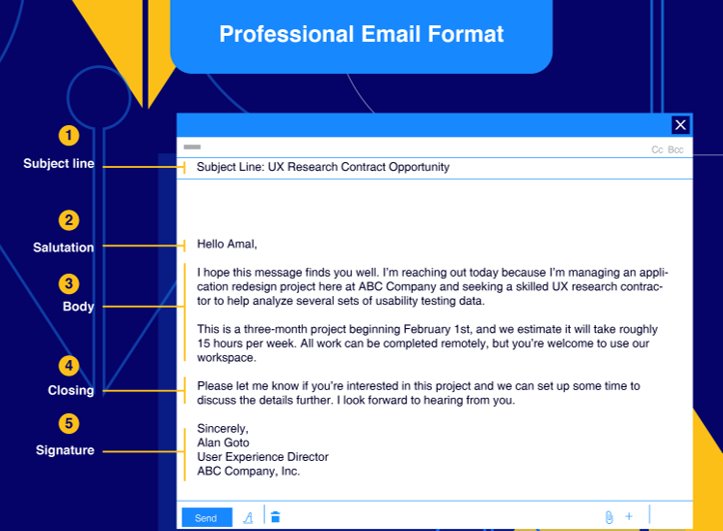
Components of a professional email

  • Subject line
  • Salutation
  • Body
  • Closing
  • Signature
Image shows a screen with an example of a professional email including Subject line, Salutation, Body, Closing, and Signature.
Image borrowed from “How to Write An Email” on indeed.com

Email Examples

The following two email examples offer some obvious and not so obvious clues to professional email writing.

Example #1

Subject:

From: Riley Gabriel​

To: Moises Hernandez​

Sup Moises,​

What are u up to next Friday at 11? I could also meet tmrw. We should meet 2 talk about office furniture. I JUST CAN’T WAIT. :/ I don’t like my chair, always hurts my back. Talk soon.​

Thanks friend,​

Riley Gabriel​

Example #2

Subject: Supply List Follow Up

From: Riley Gabriel​

To: Moises Hernandez​

Hello Moises,​

I’m reaching out to follow up with our meeting last week. We discussed purchasing new supplies for the community room for CESs to use in various events and activities. Below you will see a link to the supply list I gathered from online sources. Are you able to pick up a few things from stores? Let me know if I missed anything we talked about. ​

Thanks for your help,​

Riley Gabriel​

Pronouns: they/them​

Kalamazoo College ’21​

Program Associate – Center for Civic Engagement

Notice that Example 1 uses an informal greeting (used only if you know your recipient well and informality is established), text shortenings, ALL CAPS, complaining, and an informal closing (could be acceptable depending on level of formality).

Notice that Example 2 has an appropriate greeting, establishes the reason for contact, uses proper grammar, includes a closing statement, and a professional signature (optional). However, it is missing a link to the supply list, specific instructions about what supplies to purchase (and from what stores).

Example Greetings

  • Hi/Hello (Name),​
  • Dear (Name),​
  • Greetings,​
  • To whom it may concern,​
  • To (Name),​
  • Hello everyone,​
  • Good morning/afternoon​

Do I include titles/prefixes?

It depends. If you are writing to someone with a PhD, you can start by assuming the prefix Dr. until told otherwise. Modern advice suggests moving away from Mr./Mrs./Ms. prefixes as they are not gender-inclusive, but they may be appropriate in certain contexts.

Example Closings

Be sure to end your email with a closing. Even a simple “Thank you,” followed by your name on the next line, might suffice.

  • Best​
  • Sincerely​
  • Regards​
  • Kind regards​
  • Thank you​
  • Warm wishes​
  • With gratitude​
  • Many thanks​
  • Respectfully​

What goes in an email signature?

Email signatures can be as simple, especially if you are still a student. They may simply look like this:

Joe Hornet ’24

However, when you are writing on behalf of an organization or an employer, additional information might help give your reader context.

Examples of additional email signature inclusions

  1. Title of position & department​
  2. Pronouns
  3. Email address &/or phone number​
  4. Company logo
  5. Company physical address 
  6. Company social media links and/or website
  7. Land acknowledgement where you live/work
  8. Other important cultural messages from your organization or team

Example Signatures

Riley Gabriel​

Pronouns: they/them​

Kalamazoo College ’21​

Program Associate – Center for Civic Engagement

Reply vs. Reply All

  • Reply – Responds to original sender only. No one else originally included in the message will see your reply.​
  • Reply All – Responds to everyone that received original email. Very good for scheduling, for example letting everyone know “I’ve got this one!”​

Depending on an organization’s culture, reply all may be preferred to keep everyone in the loop as decisions are made via email. ​

CC vs. BCC

  • CC – Stands for “Carbon Copy”. Add additional recipients to a message that may need to be kept in the proverbial loop, but may not need to respond. ​
  • BCC – Stands for “Blind Carbon Copy”. ‘Blind carbon copy’ is a way of sending emails to multiple people without them knowing who else is receiving the email. Any emails in the BCC field will be invisible to everyone else in the To and CC fields. BCC should only be used when it isn’t a personal email topic and you want to keep the receipts email address private.​

Depending on an organization’s culture, a supervisor may prefer to be CC’d on certain types of messages. BCC can be used in confidential situations. ​

Subject Lines and Threads

The subject line should communicate exactly what the email is about so that the recipient can prioritize the email’s importance without having to open it.​

Good Examples of Subject Lines:

  • Time conflict for meeting 10/13​
  • Fall ’22 Term Report​

Bad Examples of Subject Lines:

  • [no subject]​
  • Hey​

Using the Reply or Reply All function will automatically generate a subject line that is formatted as: “RE: [original subject line]”.​ This helps a recipient search their Inbox for a conversation. A Thread is a set of multiple emails with the same subject line.

DO: Reply All and CC a new person to loop them into an on-going thread.​

DON’T: Changing subject lines mid-thread can cause confusion.​

The “body” of your email

The “body” of your email refers to the text that is between the greeting and the closing; it’s the main text. If you are writing to someone new, err on the side of formality in your tone for best results. Once you are familiar with your recipient/team/organizational culture, your tone can change over time.

Be clear and concise in your message— make sure you have a specific ask. If you find that your message is running very long, needs multiple caveats, or is about something delicate, email may not be the best medium. Instead, use an email to ask for a time to talk in-person (or via video/phone) to work through conflicts. Remember that emails can be forwarded or shared. When in doubt, think: “What [unintended] consequences could there be if what I have written were published on the front page of a newsletter or shown to my boss?”

Need Help? Stop by the Career Studio

If you are working on an email (especially to a potential employer, or an alum) and you’re feeling stuck, stop by the Career Studio. We’re happy to help you make your best first impression!

Is Forage legit?

Research shows that almost half of college students do not have a clear understanding of what different employers do. Forage aims to change that. Of course, before I recommend any platform or product to students (even if it is free) I explore it myself. I want to know if it’s legit, if it is helpful, and if I’d want to stake my own reputation on its recommendation.

This fall I chose two different job simulations with Forage: one focusing on data visualization and one focusing on marketing. 

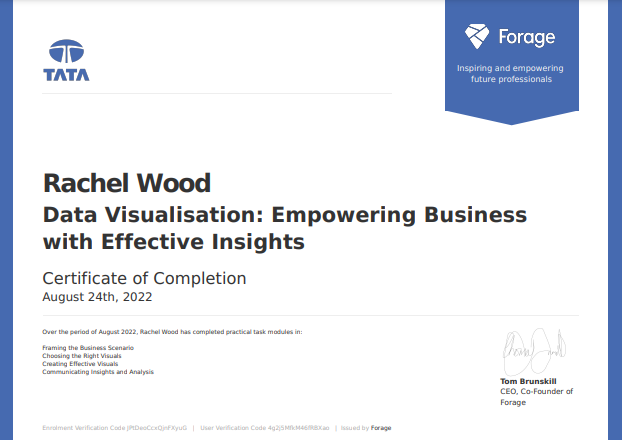
Screenshot of a Forage job simulation completion certificate as an example of what a student could earn.

Data Visualisation Job Simulation

For my first project, a company called Tata pointed me to tutorials for data visualization tools, and gave me data to analyze. I created real data visualizations to answer questions from the CEO and CMO. I also recorded a video describing what I did and how I did it. Between reading the materials provided, watching some tutorials (where I learned skills I’ll actually use in the future), and completing hands-on activities, the whole project took me about six hours.

Omnichannel Marketing Job Simulation

For my second job simulation, I chose a marketing role with lululemon. After extensive research, I ended up writing a creative brief for a marketing campaign for their new Mirror product. That project took me about three hours, but it could have taken me less had I not gotten “into it” as much as I did.

Insights

Full disclosure? I started a few other simulations as well, but I didn’t complete them. This is okay! Those companies (and you, dear reader) won’t know that I quit after I began. My name is oblivious to them. However, I did get to jump into something I initially thought might be interesting. Once I realized it wasn’t for me, I quit and moved to something else. 

After submitting my own work for both completed projects, I got to see “model” answers. These allowed me to compare my efforts to what the company considered excellent work. I did some self-evaluation and noted where I might improve in the future.

Here’s the key point: I was able to submit these work practices to Forage without showing them to the employers involved. Neither lululemon or Tata will see my work, because I chose not to share it. 

Why is that important? You might follow that same path if you are simply “trying out” a job. You might quit half-way through when you say “Ya… this job isn’t for me.” Doing a job simulation lets you get a glimpse into what someone actually does while they’re at work; instead of just reading about it, you’re doing it.

Conversely, anyone who wants to may share their work. Maybe you want to apply for an internship or job at the very company for whom you do a job simulation? In that case, you can submit your work for an advantage in the application process. Recruitment is, afterall, why the companies agree to participate and provide job simulations in the first place! According to Forage’s own Outcomes study, employers are twice as likely to advance a “Forager” to the interview stage with their organization, and four times more likely to extend an offer.

I’m not applying to Tata or Lululemon. However, I now have a digital badge/certificate that I could add to my resume, LinkedIn profile, etc. I could showcase these work experiences without having to have had an internship or job with either company. I think that’s pretty great.

Pros and Cons

  • Pros of Forage:
    • Helped me learn about the jobs of a data visualization specialist and a omni-channel marketing specialist
    • Helped me create potential work for my portfolio
    • Helped me make a connection to the two companies for further internships/career
  • Cons of Forage:
    • Projects take time
    • Projects are simulations, and therefore are unpaid

Interested in learning more? Check out Forage for yourself.

Record #’s of students at Career Studio

This Winter saw record numbers of K students visiting the Career Studio— and we expect that this will only continue as we head in to Spring.

Haven’t visited us yet? Check it out— we’re here to help you. No question is silly, no visit is too late (or too early!) in your college career. We can’t wait to talk with you about your upcoming summer plans, new major, or next steps after graduation.

Stop by Weeks 1-10, 10 AM-2PM, Monday through Friday in Dewing Basement or on MS Teams at: https://bit.ly/KVirtualCareerStudio.

What Can I Do With This Major?

Excited for Declaration of Major Day next week? The CCPD’s resource, “What Can I Do With This Major?” gives you some great ideas of not only career paths but links to job outlooks, professional networks, etc.

Whether you’re exploring majors or searching for information about your chosen field, this website will help. Learn typical career areas and types of employers that hire in these fields, as well as strategies to make you a more marketable candidate. Continue your research through the websites provided.

Logo for What Can I Do With This Major service with additional logo stating Kalamazoo College CCPD and Handshake

Masking Up The Interview

“I wear a mask. And that mask, it’s not to hide who I am, but to create what I am.” – Batman

Superheroes wear masks. That’s what I told my son as we walked to his first day of kindergarten. We had been preparing by wearing the mask around the house. But, since he hadn’t been inside a building other than our house in several months, he didn’t have much experience.

Us adults? We’ve all had plenty of time to get used to wearing masks. However, we might not have thought about how they might impact our job search— especially when it comes to in-person interviews.

Lego Batman

It’s important to take mask-wearing seriously. And even more important to do so in an interview, since you may be in close contact. Keep these tips in mind:

  1. Wear the mask properly. A properly worn mask must be worn over the nose and over the chin. Anything below the nose and above the chin puts you and the interviewer at risk. It is important to keep in mind that you are wearing a mask for your protection and for the employers’ protection. If you are both wearing masks, the chance of spreading infection decreases significantly. 
  2. Practice. Make sure you can be heard clearly and that you can articulate through the mask without sounding muffled. Practice at home in front of a mirror, record yourself, or practice by speaking to someone directly while wearing it. While half of your face is covered, be sure to practice an appropriate tone of voice, projection, and articulation.
  3. Notice your non-verbal cues. Facial expressions are harder to read. Consider the story your eyes are telling. Worry less about using hand gestures to help get your point across. Be mindful of your overall body language.
  4. Safety first. Safety should always be the first priority when considering what mask to wear to an interview. Coordinating with your interview attire may be of interest, but is secondary to function. Refer to CDC guidance on appropriate masks types and usage.
  5. Plan your specific mask choice. Don’t just grab a mask last-minute. Consider your options. Is your mask visibly clean? Do you want it to match your interview outfit? Do you want it to make a creative/artistic statement? Will your political or social affiliation, sarcastic comment, etc. help or hurt you in this particular situation? Answers to these vary by individual— think critically ahead of time and go with your gut. We recommend keeping things professional at all times.

CONCLUSION

“The mask is not for you, it’s to protect the people you care about.” (Batman, of course.)

In-person interviewing in the time of COVID-19 takes extra planning and precautions. Keep mindful that the interviewers themselves are also relatively new to this, and everyone is likely to give grace regarding the slightly awkward realities that inevitably happen.

Questions to Ask to Assess an Organization’s Commitment to Diversity, Equity, and Inclusion

As you become more engaged in racial justice and social impact, you may become increasingly conscious of diversity, equity, and inclusion (DEI) during your job search activities. You may want to know if a potential employer values DEI.

“Conscious job seeking is searching for employment or contractor opportunities that align with your vision, mission, values, and goals,” explains Chelsea C. Williams, founder and CEO of College Code.

According to Williams, students using conscious job seeking change their mindset from just getting a job to actually seeking an opportunity that aligns with their “big picture.”

Although DEI is not an important value for every student, for those who believe it matters, it is important to ensure that they are working within a company whose values match theirs. Williams says that a company that truly values DEI:

  • Has made commitments to foster a safe and healthy work environment;
  • Is taking actionable steps to improve representation across all levels and titles;
  • Holds leaders, managers, and employees accountable for actions and behaviors; and
  • Has sought to center equity through all aspects of the employee process—recruitment, training and development, promotions, pay, benefits, and more.

You can assess an organization’s commitment to DEI, in part, by asking potential employers questions that can help you to differentiate between organizations that have taken performative steps in this area and others that are truly committed to advancing DEI and have made progress.   

“Asking questions will often provide students with an understanding of where the company is in their DEI journey,” Williams notes.

Williams offers a list of thoughtful questions that students might ask recruiters during interviews or other interactions to assess their organizations’ DEI priority and commitment:

  • How does your organization define diversity? What lenses of diversity has your organization made a direct commitment toward?
  • Does your organization have a chief diversity officer (CDO) or a designated leader to drive DEI and engage internal and external stakeholders? 
  • What social causes does your organization support?
  • Does your organization actively support diverse suppliers, contractors, and small businesses?
  • Has your organization made any formal commitments in support of racial equity?
  • How does your organization center diversity, equity, inclusion, and belonging?
  • Does your organization offer any formal employee training around biases, anti-racism, or general DEI?
  • How has your organization prioritized executive accountability toward DEI advancement?
  • Does your organization have any affinity groups or committees to support diverse populations? If so, how do these groups contribute to the culture of the organization?
  • Does your organization complete annual compensation equity analysis?
  • What resources has your organization provided to its employees in support of COVID-19 and racial injustices?

The answers you receive could help you make a decision about which employers to pursue employment with and those with which, perhaps, to end the recruiting process because their values do not align.

“Students are looking for authenticity and progress from employers,” Williams explains. “An organization may not check of all their boxes around DEI, but maybe it has made the commitment to do and be better. That’s wonderful!”

Courtesy of the National Association of Colleges and Employers.